Premium Recommendation -Stony Meteorite
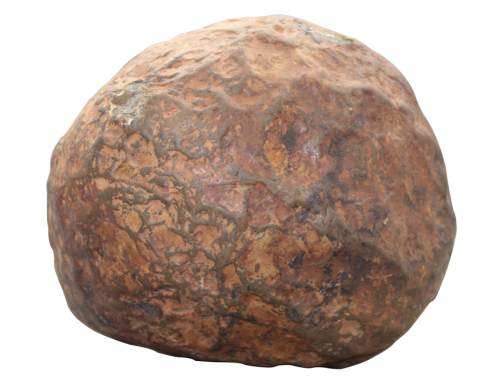
*本次藏品:石陨石*
典藏尺寸:重:8.5kg
在已知的陨石中,石陨石占比高达 94%,是太阳系最常见的 “信使”。它们主要来源于火星与木星之间的小行星带,是小行星碰撞破碎后的残骸。根据国际陨石学会(Meteoritical Society)的分类体系,石陨石可分为球粒陨石与无球粒陨石两大类:前者保留了太阳系形成初期的原始球粒结构,占所有陨石的 91.5%;后者则是小行星熔融分异后的产物,成分与地球岩石更接近。
而图中的陨石属于普通球粒陨石(H 型),这是石陨石中最常见的子类 —— 全球已发现的普通球粒陨石超过 5.6 万件,其中 H 型(高铁群)占比约 43%。它的核心特征是含铁量较高(25%-31%),因此具有明显的磁性,这也是民间初步鉴别陨石的关键依据之一。
这块陨石最显著的标志是二次熔壳—— 它的表面并非单一的黑色玻璃质层,而是呈现出棕褐色、粗糙斑驳的质感,部分区域甚至露出内部的硅酸盐基质(如图中浅色的剥落面)。
熔壳的形成是陨石穿越大气层的 “烙印”:当陨星体以 11-72 公里 / 秒的速度冲入地球大气,前端空气被剧烈压缩,温度瞬间升至 1000-2000℃,表面物质熔融成液态。随着陨石减速(落地前终速约 100-200 米 / 秒),熔融物质快速冷却,形成厚度约 0.5 毫米的玻璃质初始熔壳(通常为黑色、光洁)。
而二次熔壳的形成,则是因为陨石在大气层中发生了低空爆炸:当陨星体下降至 11-30 公里高度时,不均匀的空气压力使其碎裂,新的断裂面暴露在高温气流中,再次熔融形成薄壳。这类熔壳的特点是颜色较浅(棕褐色)、厚度更薄(0.01-0.12 毫米)、气印不完整,且表面常带有 “烟熏状” 的粗糙质感 —— 这正是图中陨石的典型外观。
除了熔壳,这块陨石还展现了石陨石的经典宏观特征:
气印:表面分布着大小不一的凹坑(如图中的不规则凹陷),这是高速气流冲刷熔融表面形成的旋涡状痕迹 —— 类似手指按压软泥留下的印记,区别于地球岩石的撞击坑或侵蚀坑。
形态:呈不规则椭球状,边缘因大气层烧蚀而略显圆润,但仍保留了小行星碎片的原始棱角(如图中的凸起部分)。
密度:约 3.6 克 / 立方厘米,明显高于普通地球岩石(如花岗岩密度约 2.7 克 / 立方厘米),这是因为其含有 10%-25% 的铁镍金属颗粒。
Among the known meteorites, stony meteorites account for as high as 94%, making them the most common "messengers" of the solar system. They are mainly derived from the asteroid belt between Mars and Jupiter, being the debris formed by the collision and fragmentation of asteroids. According to the classification system of the Meteoritical Society, stony meteorites can be divided into two major categories: chondrites and achondrites. The former retain the primitive chondritic structure dating back to the early formation of the solar system, accounting for 91.5% of all meteorites; the latter are products of the melting and differentiation of asteroids, with compositions closer to those of terrestrial rocks.
The meteorite in the image belongs to the ordinary chondrite (H-type), which is the most common subclass of stony meteorites. More than 56,000 ordinary chondrites have been discovered worldwide, among which H-type (high-iron group) accounts for approximately 43%. Its core characteristic is a relatively high iron content (25%-31%), thus exhibiting distinct magnetism, which is one of the key bases for the preliminary identification of meteorites among the general public.
The most prominent feature of this meteorite is its secondary fusion crust. Its surface is not a single layer of black vitreous material; instead, it shows a brown, rough and mottled texture, with some areas even exposing the internal silicate matrix (such as the light-colored peeling surface in the image).
The formation of a fusion crust is the "mark" left by a meteorite as it passes through the atmosphere. When a meteoroid rushes into the Earth's atmosphere at a speed of 11-72 kilometers per second, the air in front of it is violently compressed, and the temperature rises instantaneously to 1000-2000℃, melting the surface material into a liquid state. As the meteorite decelerates (with a terminal velocity of about 100-200 meters per second before landing), the molten material cools rapidly, forming an initial vitreous fusion crust with a thickness of approximately 0.5 millimeters (usually black and smooth).
The formation of the secondary fusion crust, however, is caused by the low-altitude explosion of the meteorite in the atmosphere. When the meteoroid descends to an altitude of 11-30 kilometers, the uneven air pressure causes it to fragment. The new fracture surfaces are exposed to high-temperature air currents and melt again to form thin crusts. Such fusion crusts are characterized by a lighter color (brown), thinner thickness (0.01-0.12 millimeters), incomplete regmaglypts, and a surface often with a "smoky" rough texture—exactly the typical appearance of the meteorite in the image.
In addition to the fusion crust, this meteorite also exhibits the classic macroscopic characteristics of stony meteorites:
Regmaglypts: The surface is covered with pits of varying sizes (such as the irregular depressions in the image). These are vortex-shaped marks formed by the scouring of the molten surface by high-speed air currents, similar to the imprints left by pressing soft clay with fingers, and are different from the impact craters or erosion craters on terrestrial rocks.
Morphology: It has an irregular ellipsoidal shape, with edges slightly rounded due to ablation in the atmosphere, but still retaining the original edges and corners of the asteroid fragment (such as the protruding parts in the image).
Density: It has a density of approximately 3.6 grams per cubic centimeter, significantly higher than that of common terrestrial rocks (e.g., granite has a density of about 2.7 grams per cubic centimeter), which is because it contains 10%-25% iron-nickel metal particles.
*本次藏品:石陨石*
典藏尺寸:重:8.5kg
一块陨石从诞生到被发现,要经历小行星母体破碎、太空漫游、大气层烧蚀、落地后的风化等多个阶段 —— 鄂尔多斯石陨石的每一个特征,都是这一旅程的 “记录”。
当陨石以约 20 公里 / 秒的速度进入地球大气层(高度约 135 公里),首先会因空气摩擦而发光,形成火流星—— 此时的温度可达 1500℃,表面物质开始气化、熔融,形成初始熔壳。
在下降至约 30 公里高度时,陨石承受的空气压力超过其结构强度,发生低空爆炸,碎裂成多个碎片 —— 这一过程中,新的断裂面再次熔融,形成二次熔壳。爆炸产生的冲击波会在地面形成声响(如 “隆隆的雷声”),而碎片则以陨石雨的形式散落。
最终,陨石在距离地面约 20 公里处减速至终端速度(约 150 米 / 秒),表面温度降至数百摄氏度,熔融物质彻底冷却,形成我们看到的熔壳。整个大气层穿越过程仅持续约 100 秒,但足以塑造陨石的外观与结构。
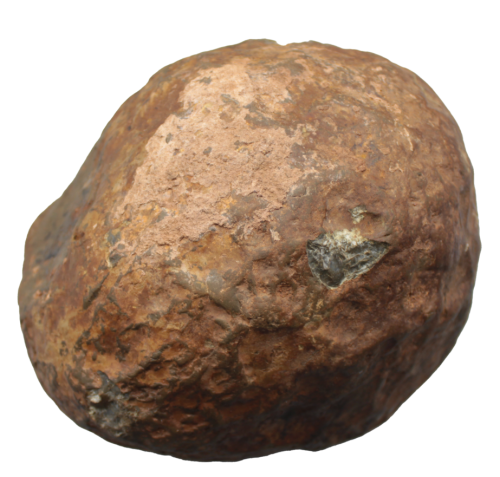
这块陨石落地后,长期暴露在的干旱环境中,表面发生了风化作用:铁镍金属颗粒被氧化成褐铁矿(Fe₂O₃・nH₂O),使熔壳呈现棕褐色;部分区域的熔壳因物理磨损而剥落,露出内部的硅酸盐基质(如图中的浅色区域)。
球粒是太阳系最原始的固态物质之一,其年龄与太阳系一致(约 46 亿年)。通过测定球粒中放射性同位素的衰变(如铀 – 铅定年),科学家可精确计算太阳系的形成时间;而球粒的化学成分,则反映了原始太阳星云的元素分布 —— 例如,H 型球粒陨石的镁 / 硅比值,与太阳光谱中的比值高度一致,证明它们是太阳星云的直接产物。
陨石的热变质程度(如岩石学类型),可揭示其母体小行星的热演化历史。例如,第 5 型球粒陨石对应的母体温度约为 600-700℃,这意味着小行星内部曾因放射性衰变而被加热,甚至发生局部熔融 —— 这一过程与地球等行星的分异作用类似,只是规模更小。
此外,陨石中的冲击熔融脉(因小行星碰撞产生的局部熔融区域),可记录碰撞事件的强度与时间,帮助科学家还原小行星带的碰撞历史。
虽然普通球粒陨石的有机分子含量较低,但碳质球粒陨石(如 Murchison 陨石)中已发现氨基酸、嘌呤等有机化合物 —— 这些物质可能是地球生命的 “种子”。而普通球粒陨石中的铁镍金属,可催化星云中的化学反应,形成复杂有机分子,为生命起源提供物质基础。
From its formation to its discovery, a meteorite undergoes multiple stages: fragmentation of its parent asteroid, wandering through space, ablation in the Earth’s atmosphere, and weathering after landing. Every feature of the Ordos stony meteorite is a record of this journey.
When the meteorite enters the Earth’s atmosphere at a speed of approximately 20 kilometers per second (at an altitude of around 135 kilometers), it first glows due to air friction, forming a fireball. At this moment, the temperature can reach 1,500℃; surface materials begin to vaporize and melt, creating a primary fusion crust.
As it descends to an altitude of about 30 kilometers, the air pressure acting on the meteorite exceeds its structural strength, triggering a low-altitude explosion that shatters it into multiple fragments. During this process, the newly exposed fracture surfaces melt again, forming a secondary fusion crust. The shock wave generated by the explosion produces audible sounds on the ground (resembling "rumbling thunder"), while the fragments scatter as a meteorite shower.
Eventually, at an altitude of roughly 20 kilometers above the ground, the meteorite decelerates to its terminal velocity (about 150 meters per second). Its surface temperature drops to several hundred degrees Celsius, and the molten material cools completely, forming the fusion crust we observe today. The entire atmospheric transit process lasts only about 100 seconds, yet it is sufficient to shape the meteorite’s appearance and structure.
After landing, this meteorite was exposed to an arid environment for a long time, undergoing surface weathering: iron-nickel metal particles oxidized into limonite (Fe₂O₃·nH₂O), tinting the fusion crust brown. In some areas, the fusion crust peeled off due to physical abrasion, revealing the internal silicate matrix (such as the light-colored areas in the image).
Chondrules are among the most primitive solid materials in the solar system, with an age identical to that of the solar system (approximately 4.6 billion years). By measuring the decay of radioactive isotopes in chondrules (e.g., uranium-lead dating), scientists can accurately calculate the formation time of the solar system. The chemical composition of chondrules reflects the elemental distribution of the primitive solar nebula—for instance, the magnesium-silicon ratio in H-type chondrites is highly consistent with that observed in the solar spectrum, proving that they are direct products of the solar nebula.
The thermal metamorphism degree of a meteorite (e.g., its petrologic type) can reveal the thermal evolution history of its parent asteroid. For example, type 5 chondrites correspond to a parent body temperature of approximately 600–700℃, indicating that the interior of the asteroid was once heated by radioactive decay and even experienced partial melting. This process is analogous to the differentiation of planets like Earth, albeit on a much smaller scale.
In addition, shock melt veins in meteorites—localized molten regions formed by asteroid collisions—can record the intensity and timing of impact events, helping scientists reconstruct the collision history of the asteroid belt.
Although ordinary chondrites have low organic molecule content, carbonaceous chondrites (such as the Murchison meteorite) have been found to contain organic compounds like amino acids and purines. These substances may have been the seeds of life on Earth. The iron-nickel metals in ordinary chondrites can catalyze chemical reactions in the nebula, forming complex organic molecules and laying the material foundation for the origin of life.
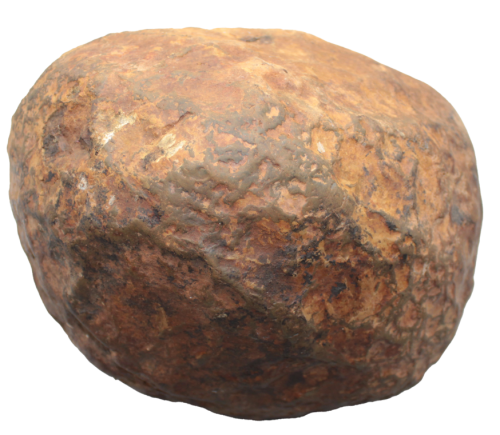
*本次藏品:石陨石*
典藏尺寸:重:8.5kg
以上藏品相关信息请与:四川尚亿拍卖有限公司联系。
For information about the above collections, please contact: Sichuan Jun Zailai Auction Group Co.